



MoiréSkin

Ultra-Sensitive Sensor–Actuator Visuo-Tactile Skin Using Moiré Patterns

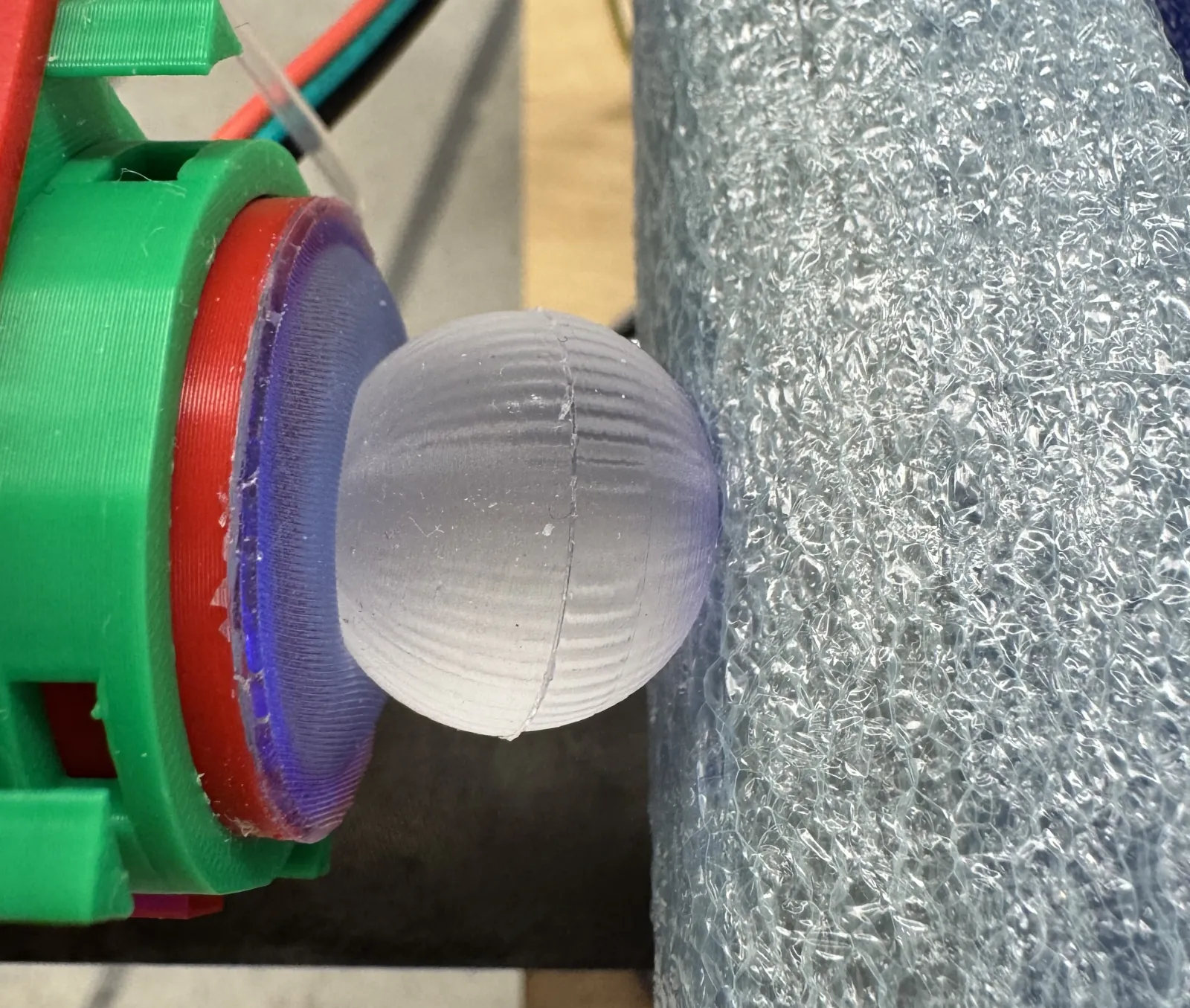
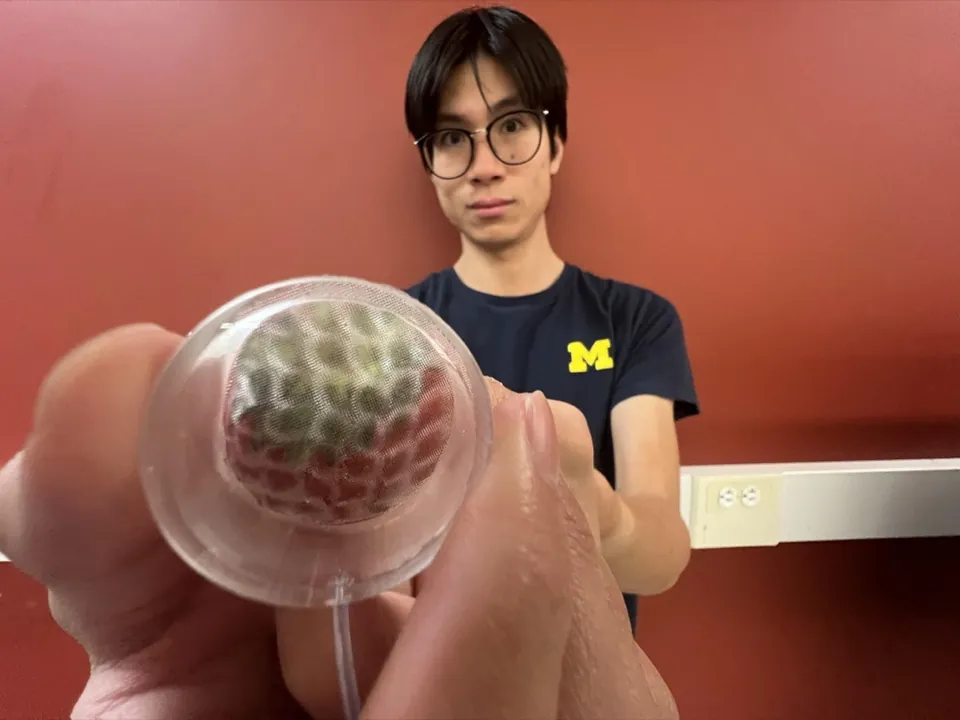
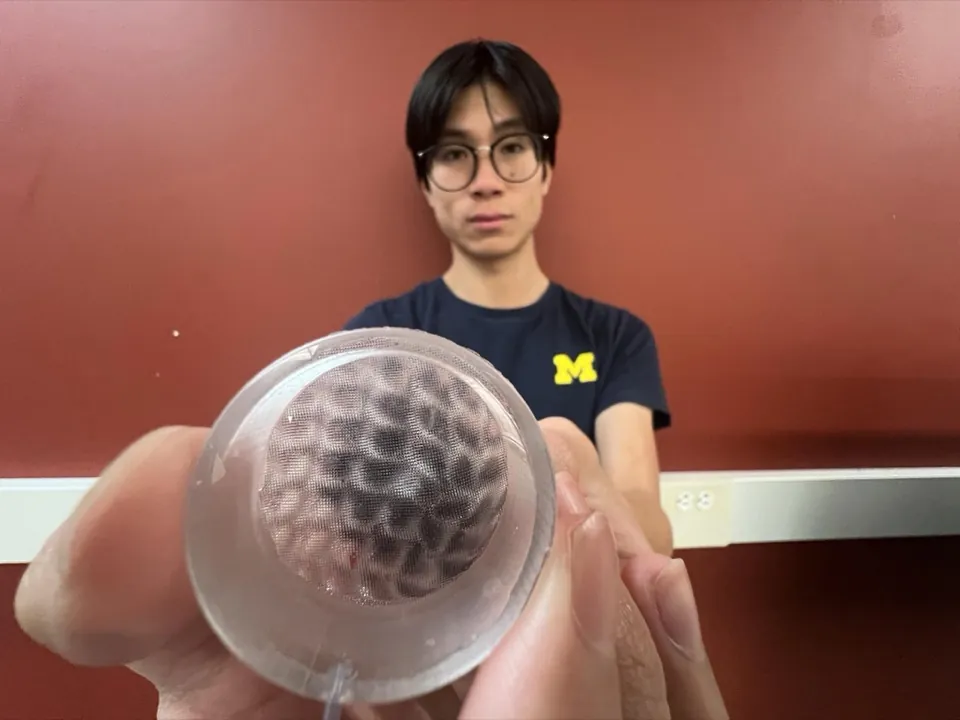
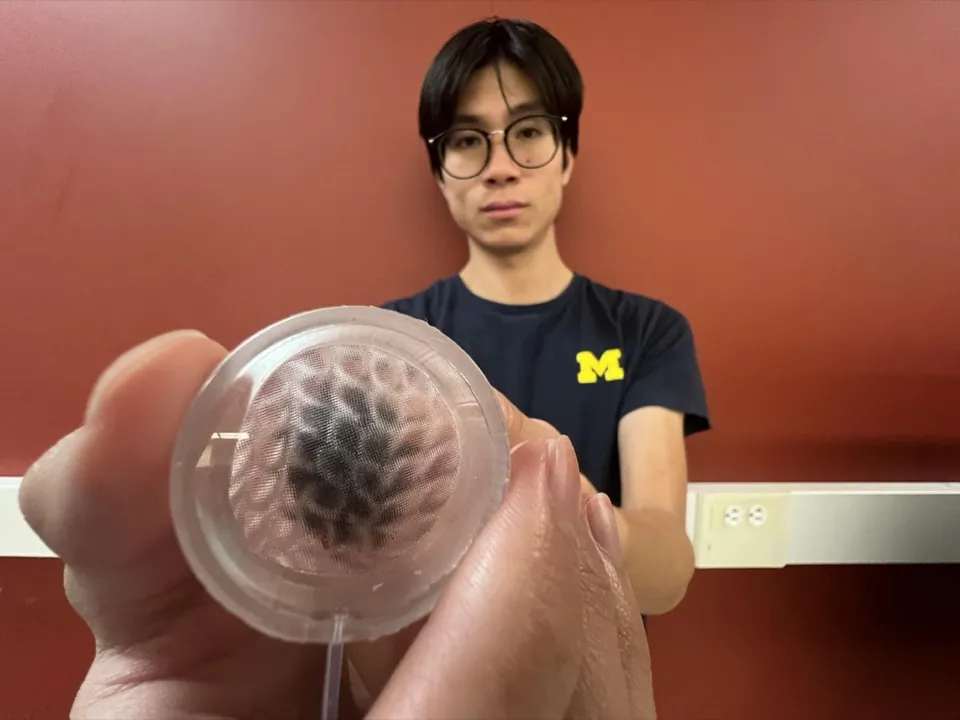
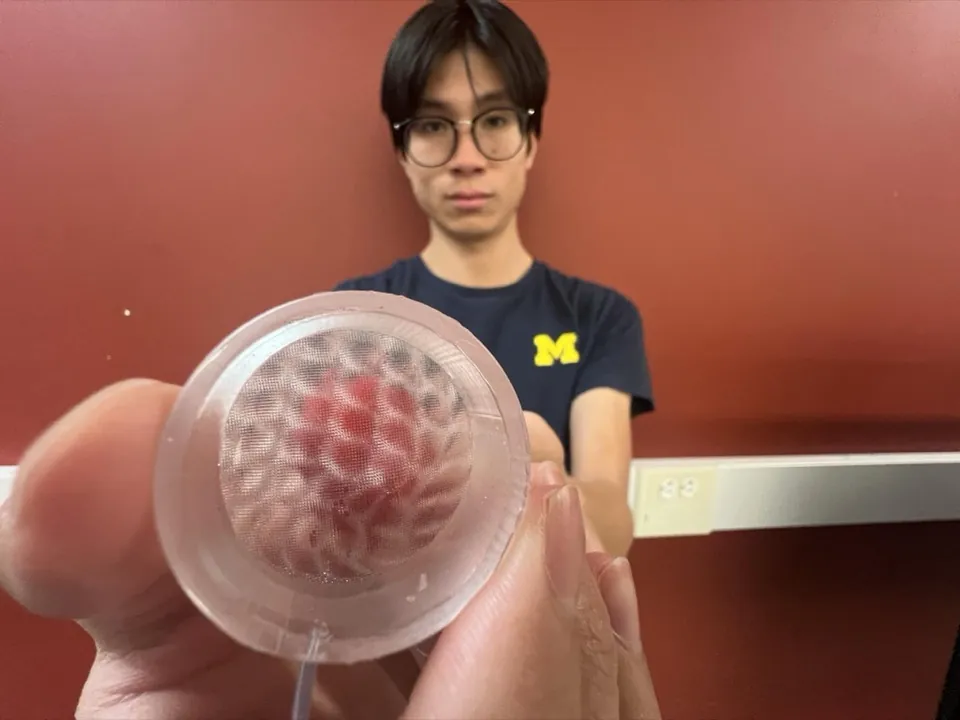
An inflatable visuo-tactile skin with dual-sided 330 μm optical gratings. Contact and pneumatic deformation shift low-frequency moiré fringes, allowing the same soft membrane to estimate touch and track its actuation state.

View artifacts Code · forthcoming
Sensor–actuator prototypeInternal fringes + external actuation
Synchronized views of moiré fringe evolution and pneumatic membrane motion. Video is experimental footage from the project deck.
3.78 mNtiny-force normal-force MAE
0.094 mmtiny-force contact-position MAE
0.151 hPacalibrated actuation-state MAE
4.146 gdynamic mass-estimation MAE

Optical principle

Microscopic strain becomes visible fringe motion.

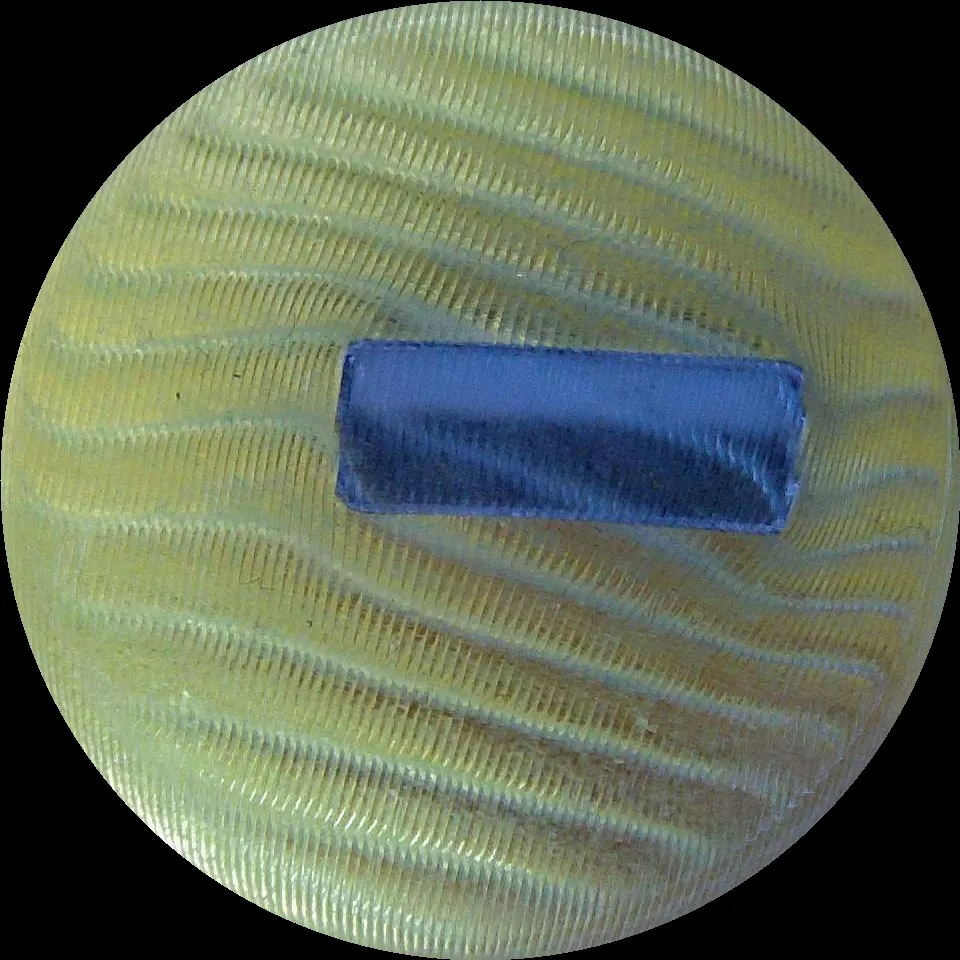
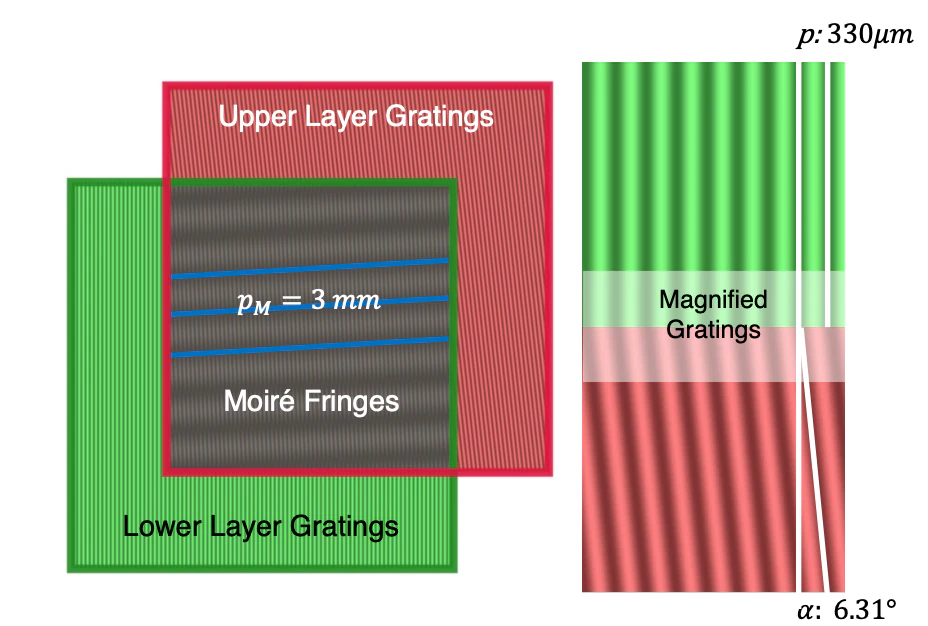
Two nearly aligned gratings create a much coarser moiré pattern. When the membrane bends, the layers stretch differently, changing the fringe pitch and orientation by an amount a camera can resolve.

Upper and lower 330 micrometer gratings overlaid at 6.31 degrees to form approximately 3 millimeter moiré fringes
The prototype uses 330 μm gratings, a 6.31° angular offset, and approximately 3 mm observable fringes.

A geometric amplifier, not an intensity marker.

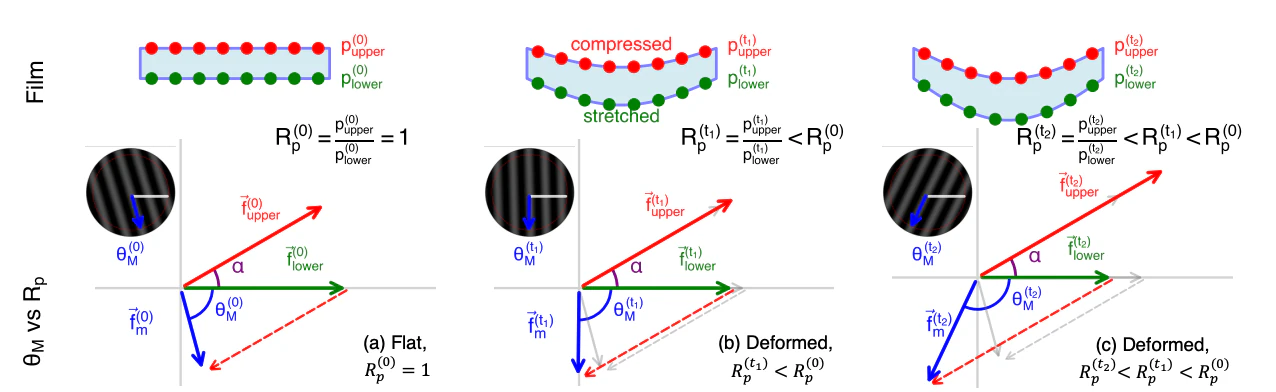
Inflation or contact changes the ratio between upper- and lower-layer grating pitch. The resulting low-frequency pattern remains visually salient even with moderate defocus.

Grating pitch
330 μm
Camera
1920 × 1080
Lens
160° field of view
Excitation
455–485 nm LED ring
Moiré fringe orientation changing as the two grating layers deform by different amounts
Flat, moderately deformed, and more strongly deformed states rotate the observable fringe direction as the layer pitch ratio changes.

Hardware and fabrication

Soft optics, internal illumination, pneumatic compliance.

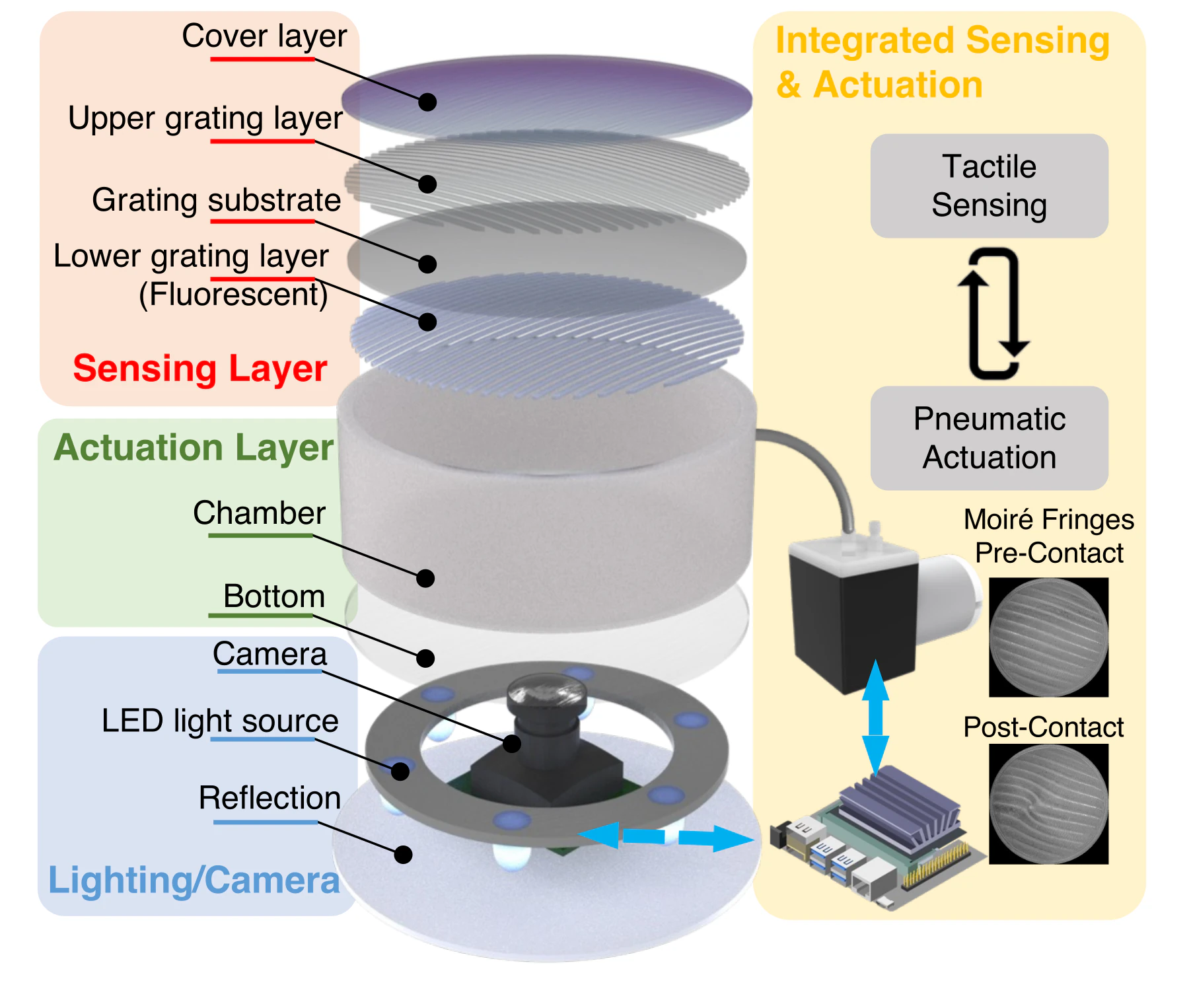
A transparent cover preserves pre-contact vision. A fluorescent lower grating and filtered internal lighting maintain fringe contrast under changing ambient light.

Exploded MoiréSkin stack showing the cover, dual grating sensing layers, pneumatic chamber, camera, LED illumination, and controller
One stack combines the flexible sensing layer, air chamber, lighting, camera, and pneumatic controller.
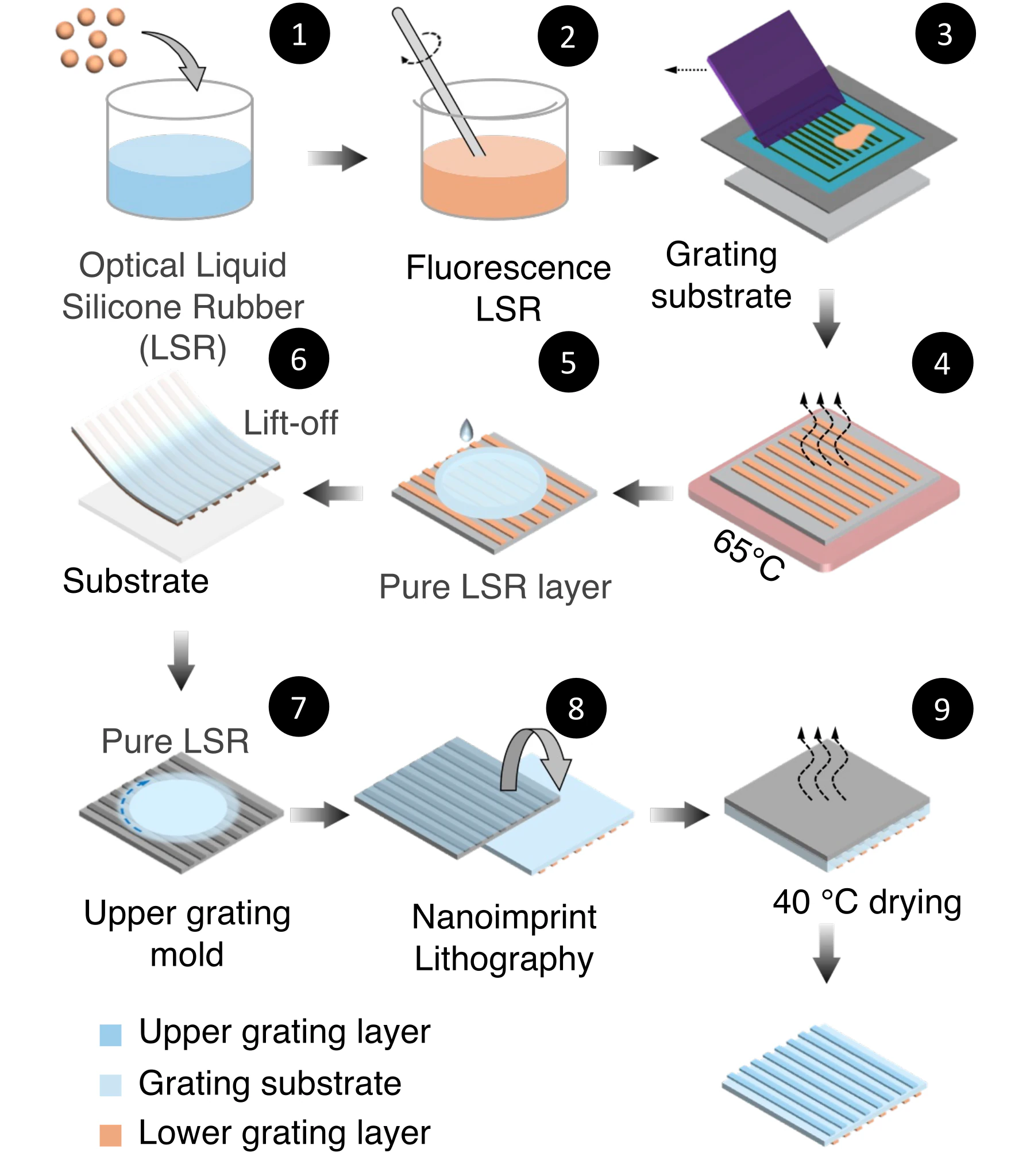
Fabrication pipeline for casting and transferring fluorescent and non-fluorescent liquid silicone rubber grating layers
Soft lithography and nanoimprint transfer form the dual-sided LSR grating film; the lower grating carries fluorescent material.

Cold-start calibration

Find the flat zero-state without pressure sensors.

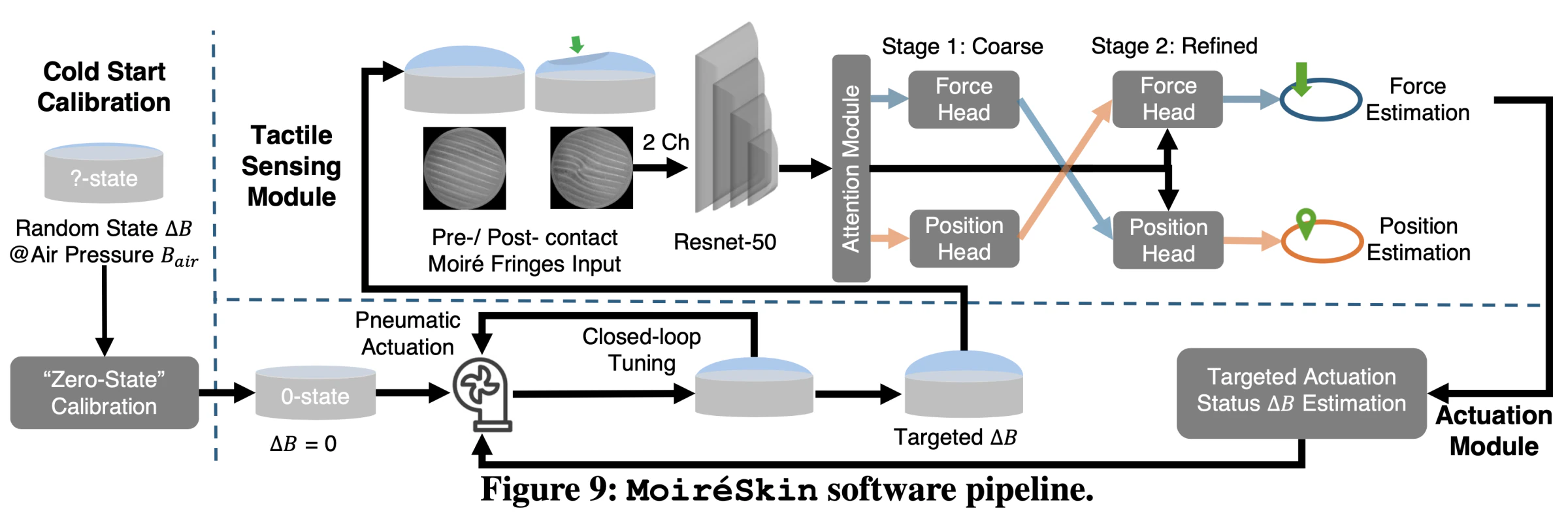
A one-time material model is fitted with two temporary barometers. During normal cold starts, the barometers are removed: peripheral and central fringe orientation identify ΔB = 0, compensating for atmospheric-pressure and lighting drift.

MoiréSkin pipeline from cold-start zero-state calibration through pre- and post-contact tactile inference and targeted pneumatic actuation
Visual zero-state calibration anchors both tactile inference and closed-loop pneumatic control.
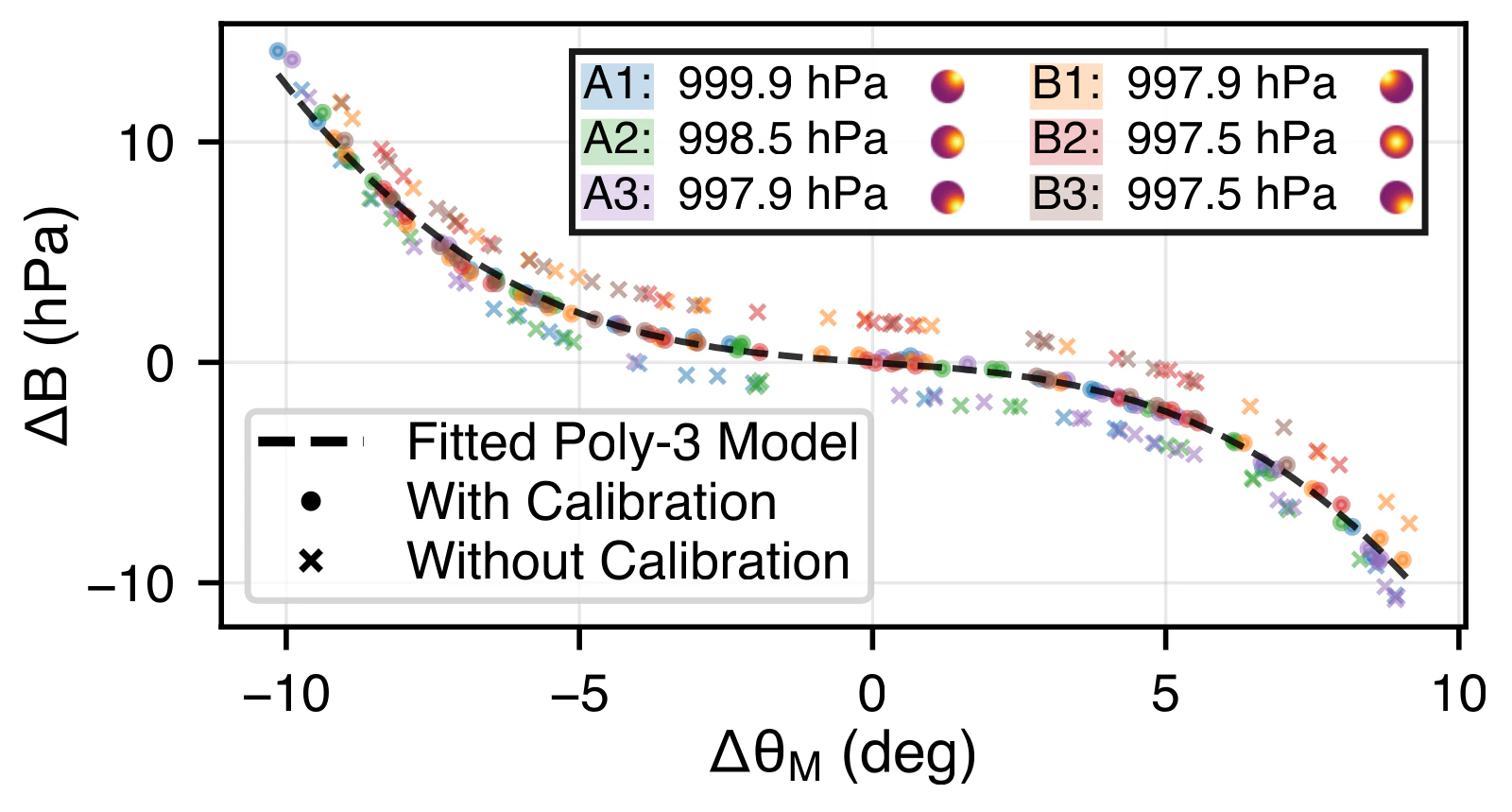
Actuation pressure difference versus moiré fringe angle across six sessions with and without zero-state calibration
Six sessions vary ambient pressure and illumination. Calibration restores the shared pressure–fringe mapping.
> 0.994R² after zero-state calibration
85%maximum RMSE reduction
1.771 → 0.151 hPaΔB MAE in high-drift sessions
≈ 2 spneumatic and zero-state convergence
Cold start and actuation — synchronized viewsThe sensor fringe field and physical membrane are shown on the same timeline while the controller traverses candidate pneumatic states.

Tactile inference

Two images, two stages, two operating ranges.

The model takes pre- and post-contact grayscale fringe images as a two-channel input. A modified ResNet-50 with attention feeds coarse force and position heads, then cross-coupled refinement heads account for position-dependent force response on the inflatable surface.

Measured contact-estimation configurations
ConfigurationForce rangeActuation stateForce MAEPosition MAE
Tiny probe0–0.4 NΔB = 03.78 mN0.094 mm
Large probe0–4 NΔB ∈ [−11, +12] hPa0.033 N0.15 mm
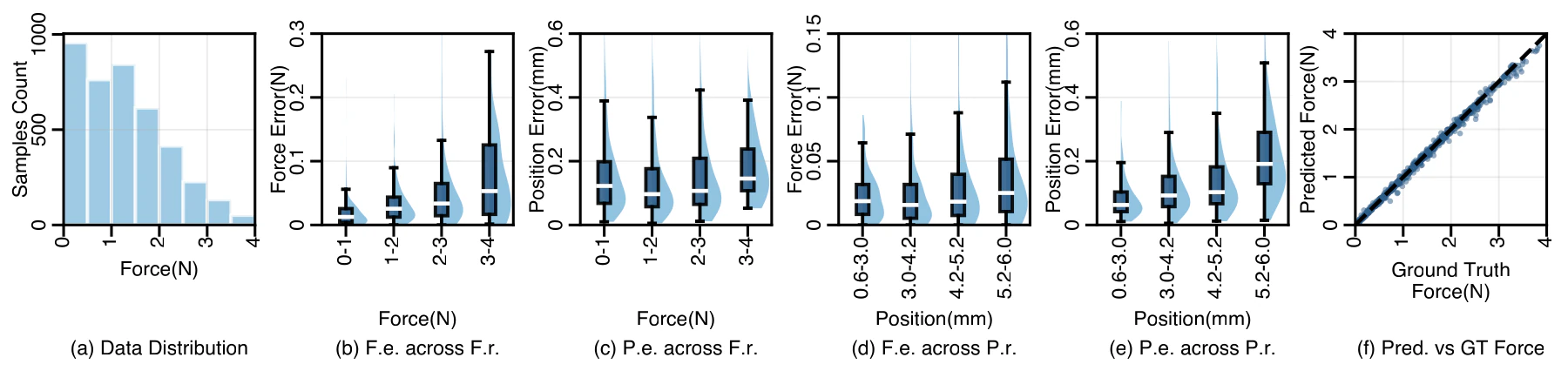
General-force setting

0–4 N across randomized actuation states

Force remains highly linear across the full range; 94.9% of force errors are below 0.1 N.

General-force evaluation plots across the zero to four newton range
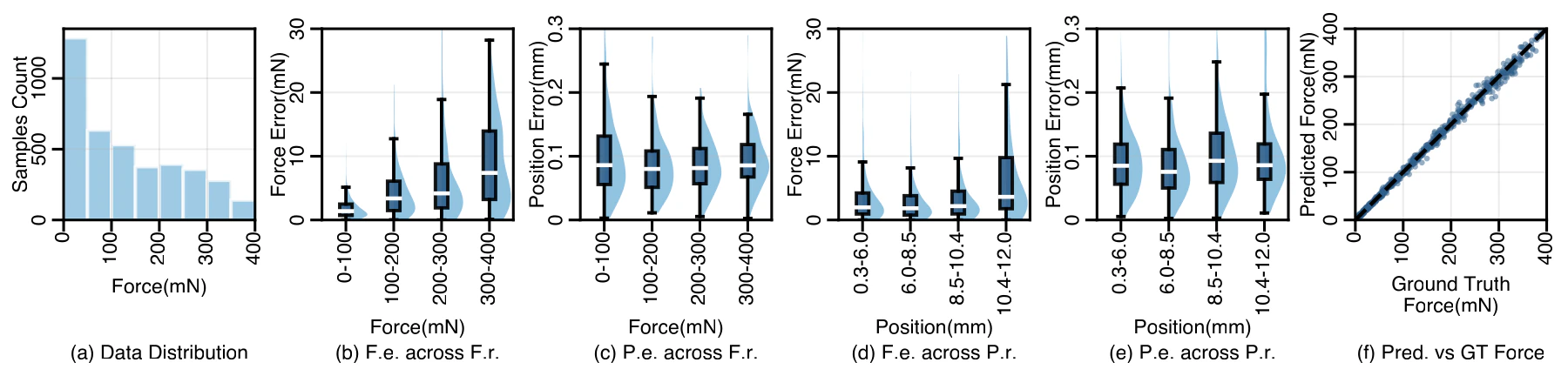
Tiny-force setting

0–400 mN at the calibrated zero-state

Error bars typically remain below 15 mN, including near the upper end of the tiny-force range.

Tiny-force evaluation plots across the zero to 400 millinewton range
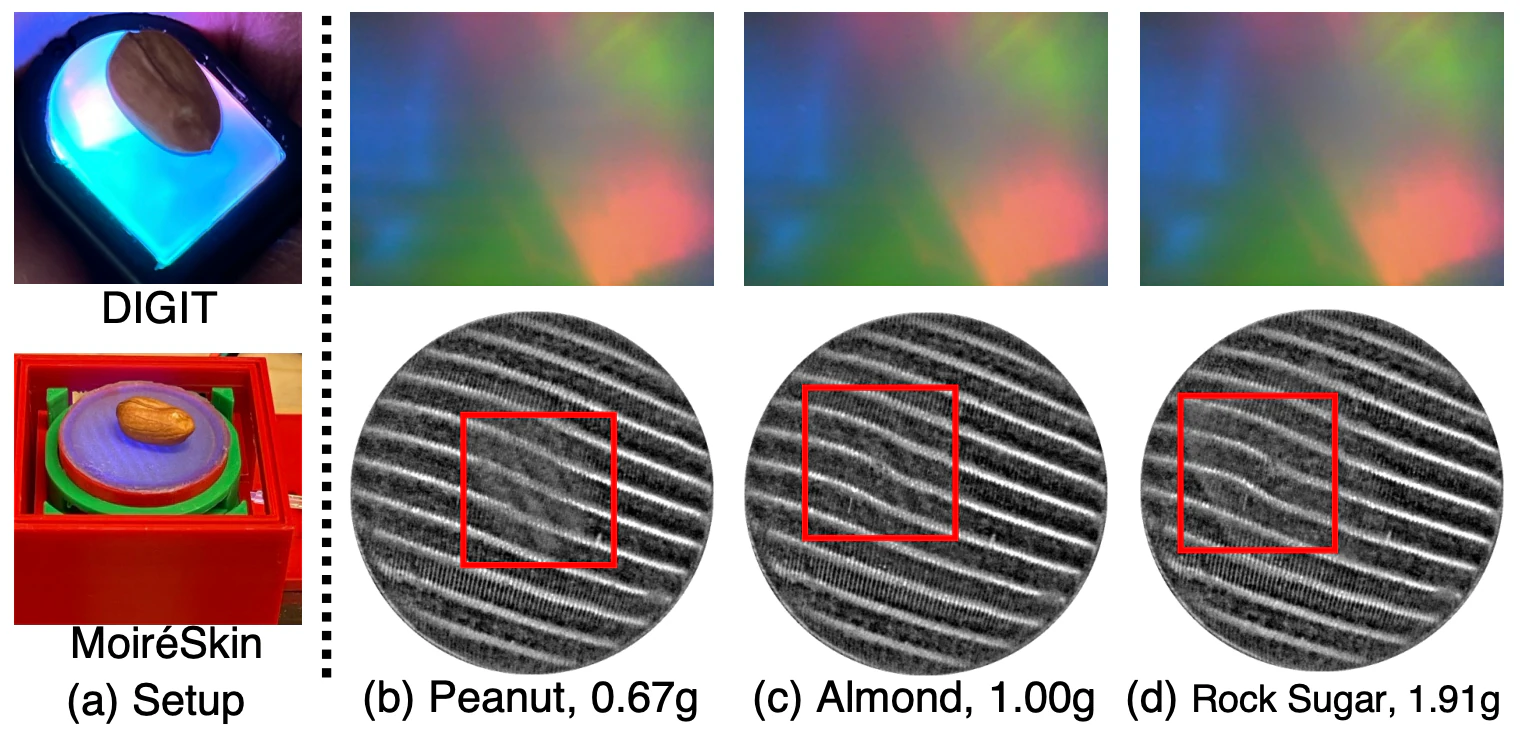
Side-by-side DIGIT and MoiréSkin sensor images for a peanut, almond, and rock sugar object
Under 0.67–1.91 g objects, DIGIT shows little visible change while MoiréSkin produces localized fringe distortion.
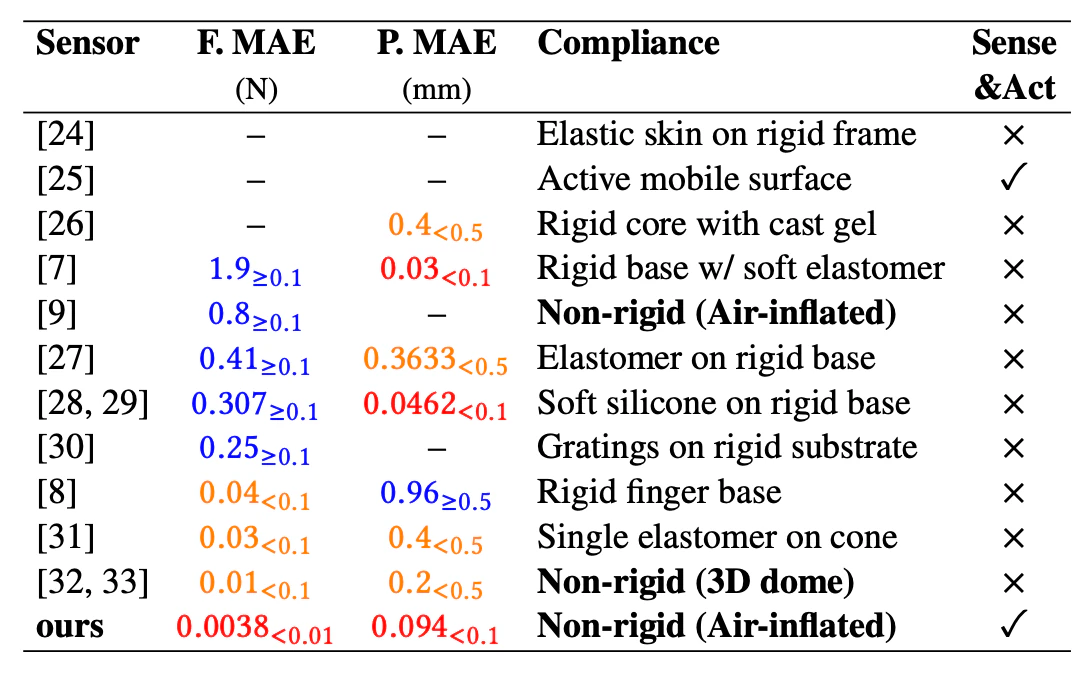
Benchmark table comparing force error, position error, compliance, and sensing-actuation integration across visuo-tactile sensors
Benchmark context: the prototype combines a non-rigid, air-inflated interface with joint sensing and actuation.

Video artifacts

Watch the sensing layer respond.

These clips are extracted from the supplied project decks and compressed for the web. They show raw internal fringe views beside the physical interactions that created them.

Gram-scale lightweight contactLow-mass objects produce visible local fringe bending in the internal sensor view.
Direct hand interaction — synchronized viewsThe internal fringe response is paired frame-for-frame with the fingertip pressing and sweeping across the membrane.
Softness probing — synchronized viewsThe internal tactile signature is shown beside the external active probe between ΔB = 0 and +41.25 hPa.

Integrated sensing–actuation studies

Controlled studies connect precision to tasks.

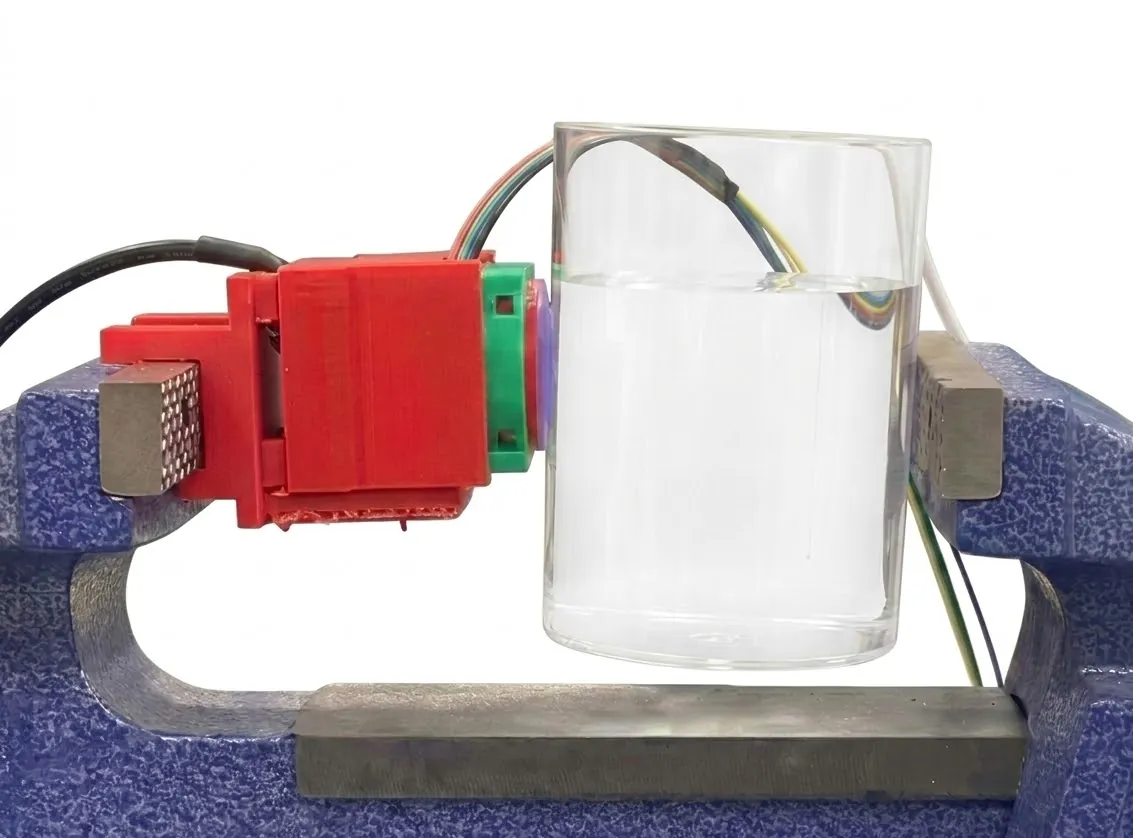
Both studies use a fixed bench-vise setup to isolate tactile changes from grasp motion. The higher +41.25 hPa actuation state is fine-tuned beyond the standard −11 to +12 hPa tactile-training range.

Study 1 · ultra-soft materials

Seven stiffness classes, two-state active probing.

Seven spheres span 8.73–21.72 kPa Young’s modulus. The pretrained general-force backbone supplies 2048-dimensional features; LDA reaches 92.7% at 5-shot and 99.7% at 10-shot over 60 sessions.

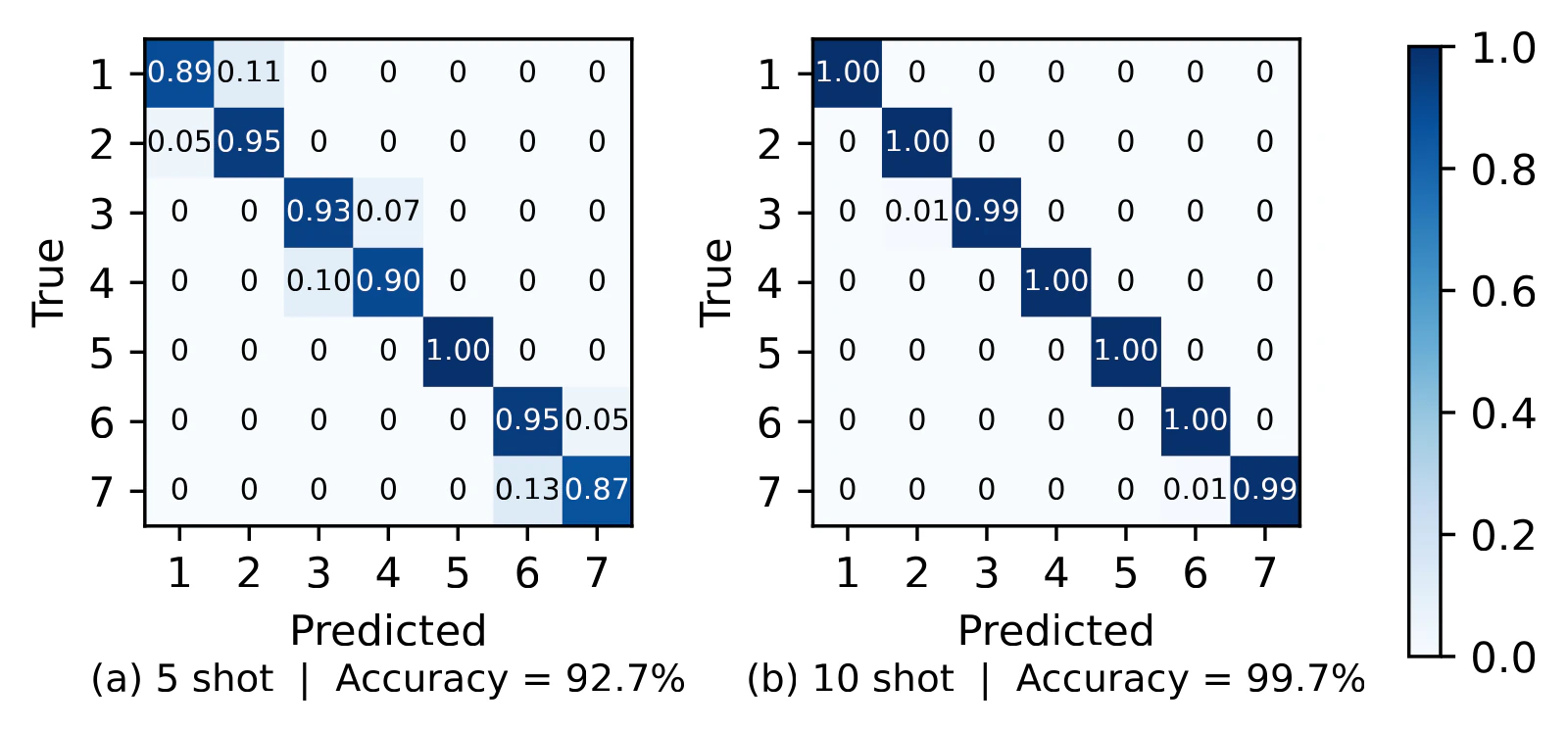
Seven soft spheres labeled from 8.73 to 21.72 kilopascals Young's modulusFive-shot and ten-shot confusion matrices for seven soft-material stiffness classesBench-vise softness classification setup using MoiréSkin

Study 2 · dynamic shear load

Track changing liquid mass from shear-force cues.

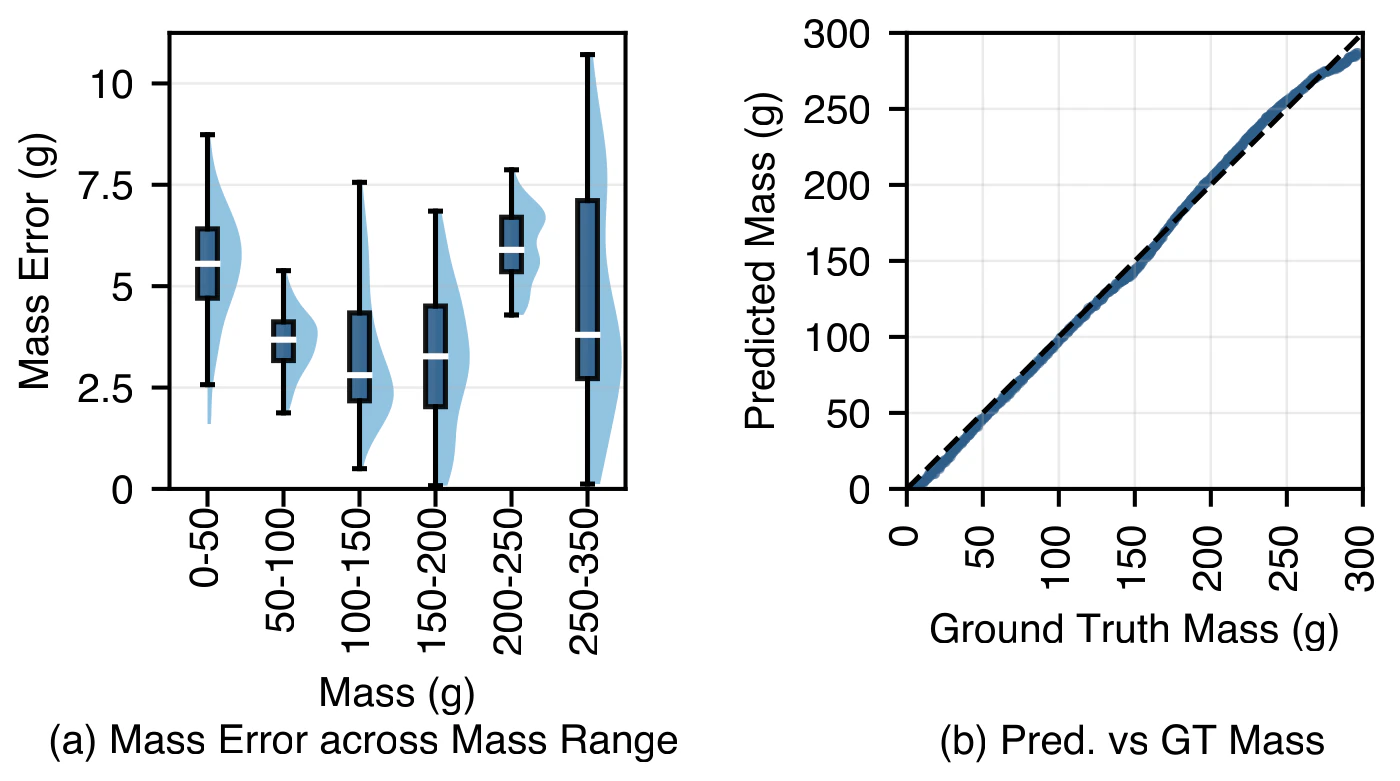
Water is added from 0 to approximately 300 mL while the cup remains at fixed position and actuation state. Across six sessions, the model reaches 4.1462 ± 0.5994 g MAE and 4.7517 ± 0.5353 g RMSE.

Mass-estimation error distributions and predicted versus ground-truth mass up to 300 gramsFixed bench-vise cup experiment for dynamic mass estimation

See-through function

Observe the object before contact.

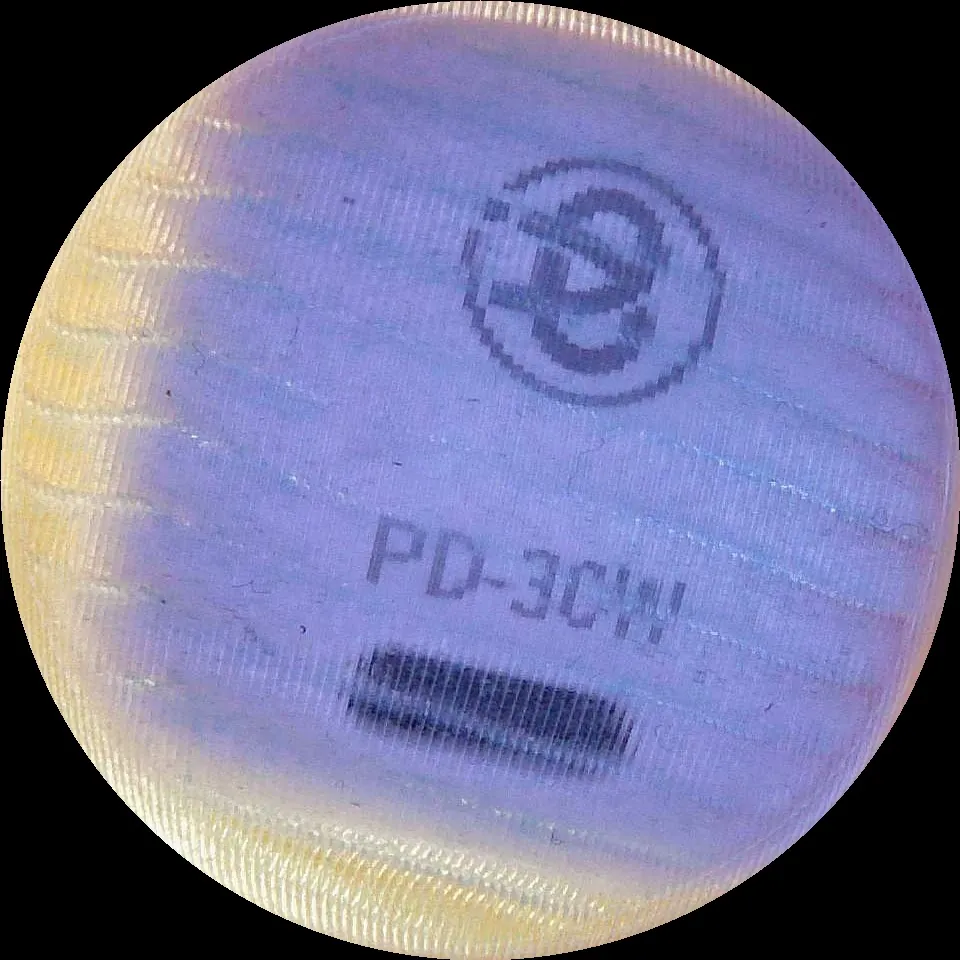
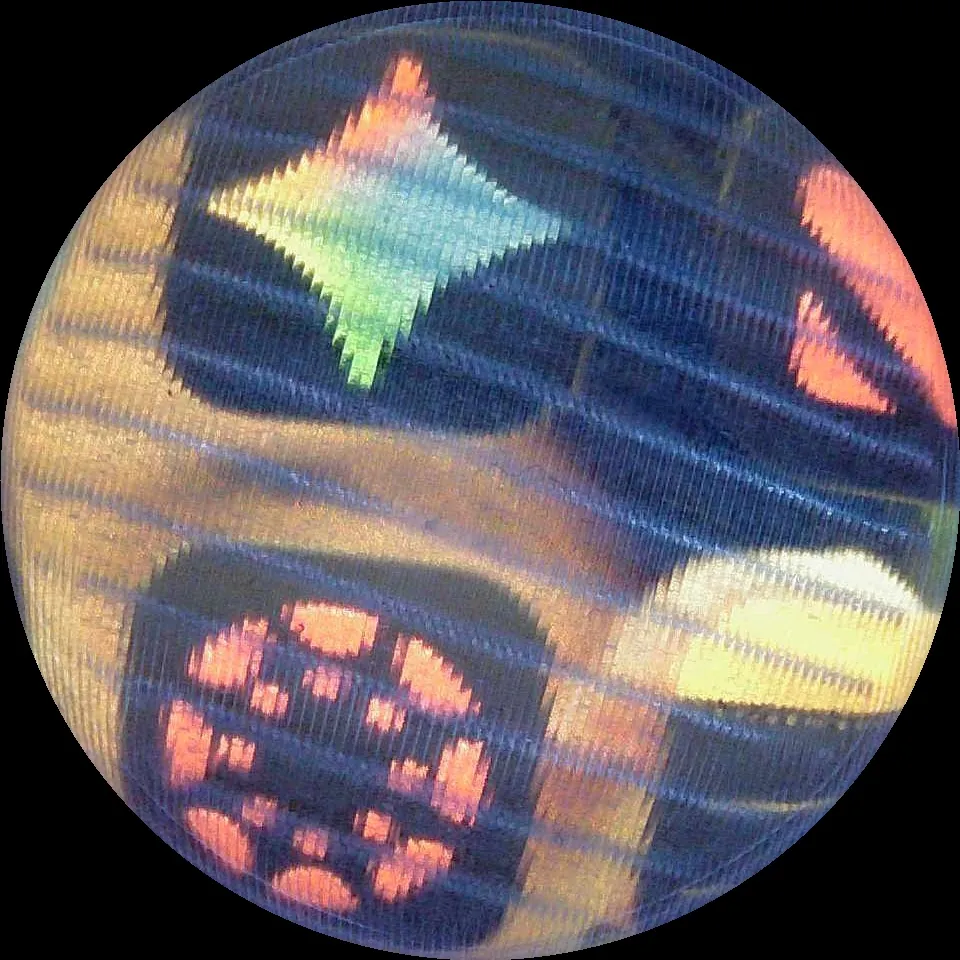
The transparent cover preserves visual access while fluorescent gratings and internal illumination keep the moiré signal readable. The prototype demonstrates a power adapter, USB-A connector, and phone display through the sensing layer.

Power adapter visible through the transparent MoiréSkin layer
Power adapter
USB-A connector visible through the transparent MoiréSkin layer
USB-A connector
Phone display visible through the transparent MoiréSkin layer
Phone display

Evidence boundary

What the current prototype establishes.

Demonstrated: tactile force and position sensing, visual pneumatic-state estimation, see-through imaging, and two controlled fixed-vise sensing–actuation studies.

Not yet demonstrated: a self-contained untethered device, larger-area skin, or closed-loop robotic manipulation on an end effector.

Next: larger sensing areas, geometry-diverse and fragile contacts, onboard computation, fatigue testing, and closed-loop robot tasks.

Resources

Explore the project.